



Care assistants and home helpers are among the most essential workers in Europe’s social infrastructure — and among the most underserved when it comes to professional development. The DIGIHEALTH project has spent twelve months building the evidence base for why digital upskilling of this workforce matters, what stands in the way, and what effective training looks like in practice. This article shares our key findings and invites the EPALE community to engage with them.
For practitioners working in adult education and vocational training, the question of how to effectively reach low-qualified workers in high-demand sectors is not a new one. But the intersection of care work, digital transformation, and workforce diversity creates a particularly complex and urgent challenge that the adult learning community has not yet fully addressed.
The European care sector is under compounding pressure. An ageing population is driving rapidly growing demand for care services. Staff shortages are acute and projected to intensify: Austria’s national workforce projection places the care staffing gap at over 90,000 by 2030 (Austrian Federal Ministry of Social Affairs, 2025). At the same time, the digital transformation of healthcare is reshaping what care work requires, even at its most frontline levels. Electronic health records, telecare platforms, remote monitoring systems, and digital communication tools are becoming standard features of home care and residential care environments.
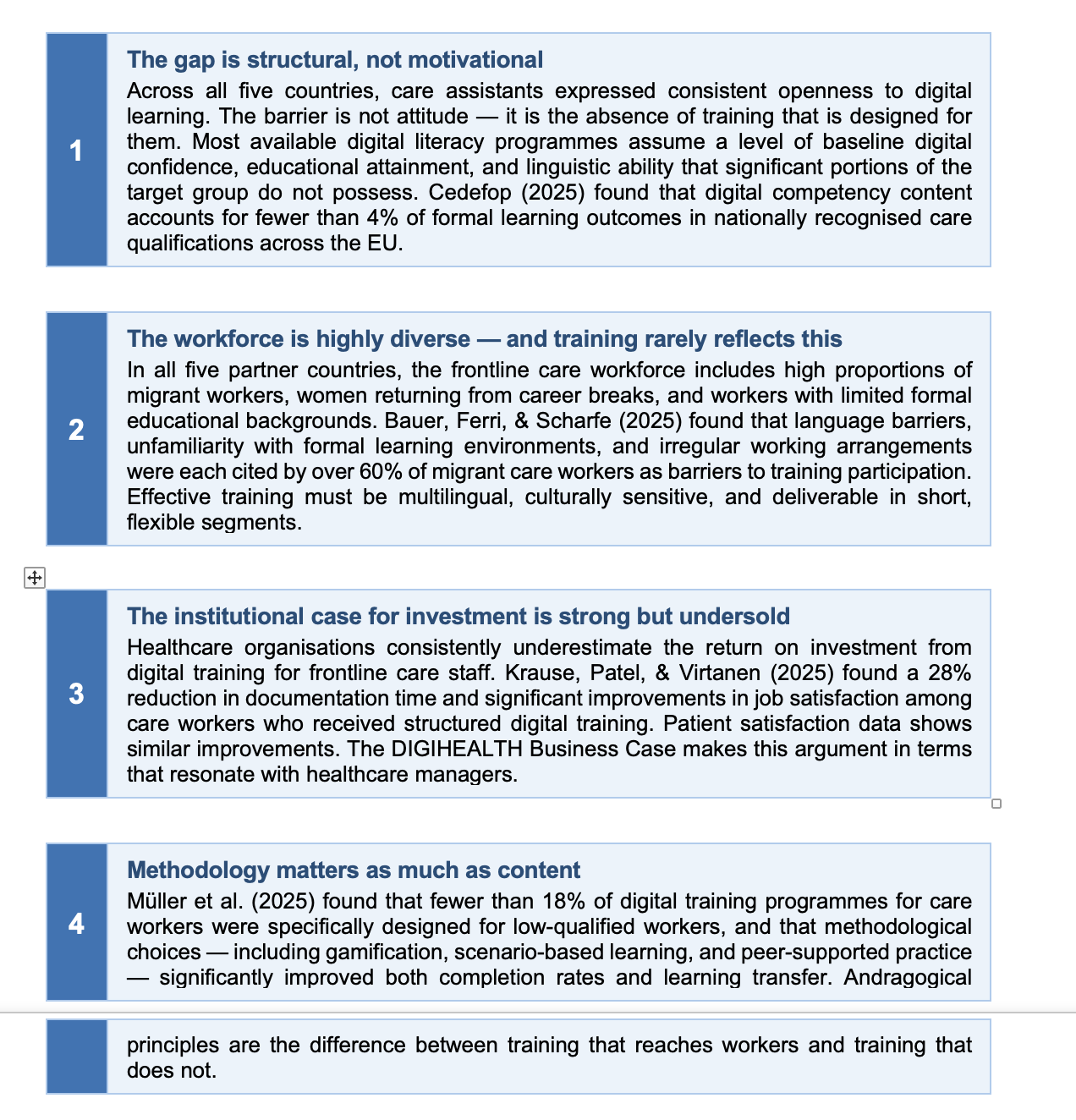
The workforce serving these environments has not kept pace. A 2025 comparative analysis by Cedefop found that digital competency content accounts for fewer than 4% of formal learning outcomes in nationally recognised qualifications for care assistants across EU member states (Cedefop, 2025). Initial VET largely fails this group on digital preparation. And the continuing education landscape is no more encouraging: provision is fragmented, often linguistically and culturally inaccessible to a workforce that is disproportionately female and migrant, and rarely designed with the constraints of frontline care work in mind.
DIGIHEALTH’s research phase aimed to answer four questions that matter for any adult learning practitioner working in this space: What is the actual state of digital competence among care assistants? What structural and individual barriers prevent access to digital training? What does the evidence say about the organisational and patient-level benefits of training investment? And what does effective training design for this group actually look like?
Our research work package — led by Ostfalia University of Applied Sciences — conducted desk research across five countries, carried out 30 structured stakeholder interviews, and produced five national reports synthesised into the DIGIHEALTH Business Case. The Business Case is now freely available from our project website.
The DIGIHEALTH E-Course and Academy curriculum are now in active development, and our design choices are directly informed by the research findings above. We share them here because we believe they represent transferable principles for any adult learning practitioner working with low-qualified workers in high-demand sectors.
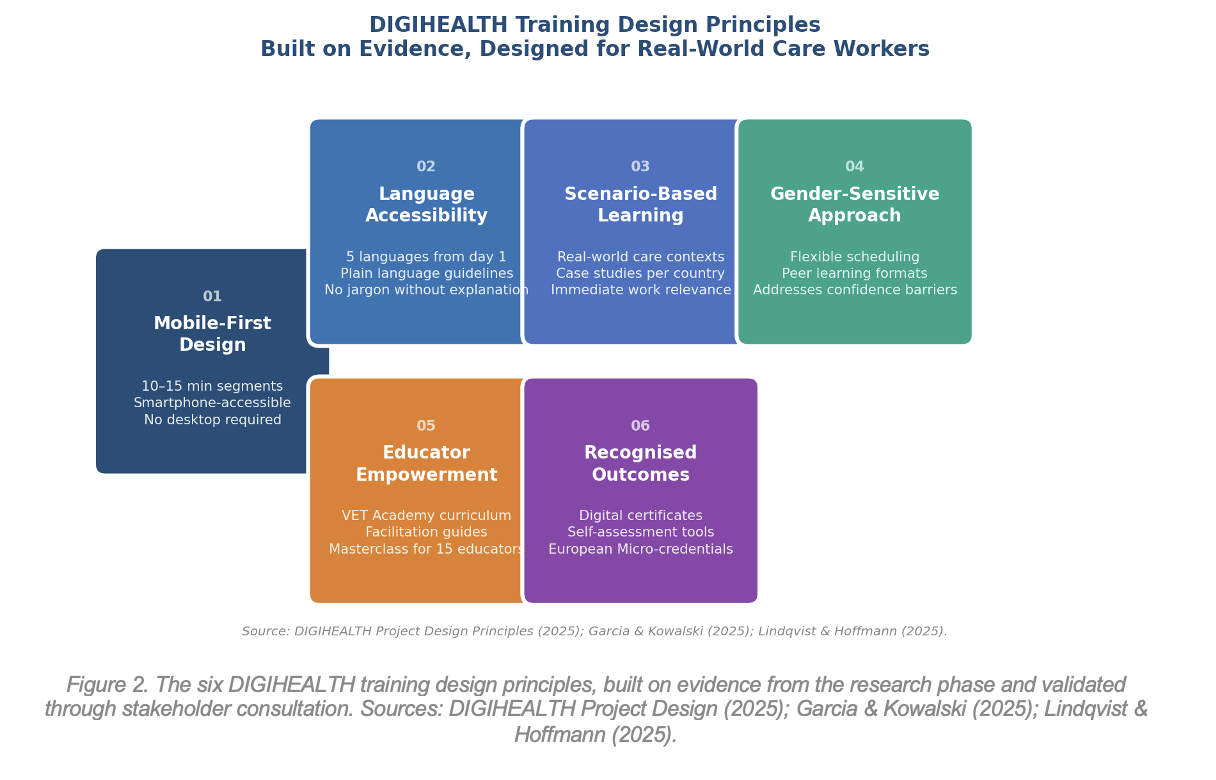
The first principle is mobile-first design. Care assistants do not have access to dedicated learning time at a desk. The course is being designed for smartphones and tablets, with content segments of 10-15 minutes that can be completed between care visits. Research on microlearning for adult workers in physically demanding roles shows significantly higher completion rates when content is delivered in short, mobile-accessible segments (Garcia & Kowalski, 2025).
The second principle is language accessibility without condescension. The course will be available in five languages, with content written from the outset using plain language guidelines and technical terminology introduced progressively. The third principle is scenario-based, contextualised learning. Each module includes case studies drawn from the national contexts of the partner countries, making explicit the connection between what is being learned and the daily situations in which it will be applied. A 2025 study in Nurse Education Today found that scenario-based digital training produced significantly higher competency assessment scores compared to information-transmission approaches, with the effect most pronounced among learners with lower prior digital experience (Lindqvist & Hoffmann, 2025).
The fourth principle is educator empowerment alongside learner empowerment — the DIGIHEALTH Academy gives VET educators a curriculum of facilitated training activities that reinforce and extend the E-Course content. The fifth and sixth principles address gender sensitivity and formal recognition of learning outcomes through digital certificates aligned with the European Micro-Credentials Framework.
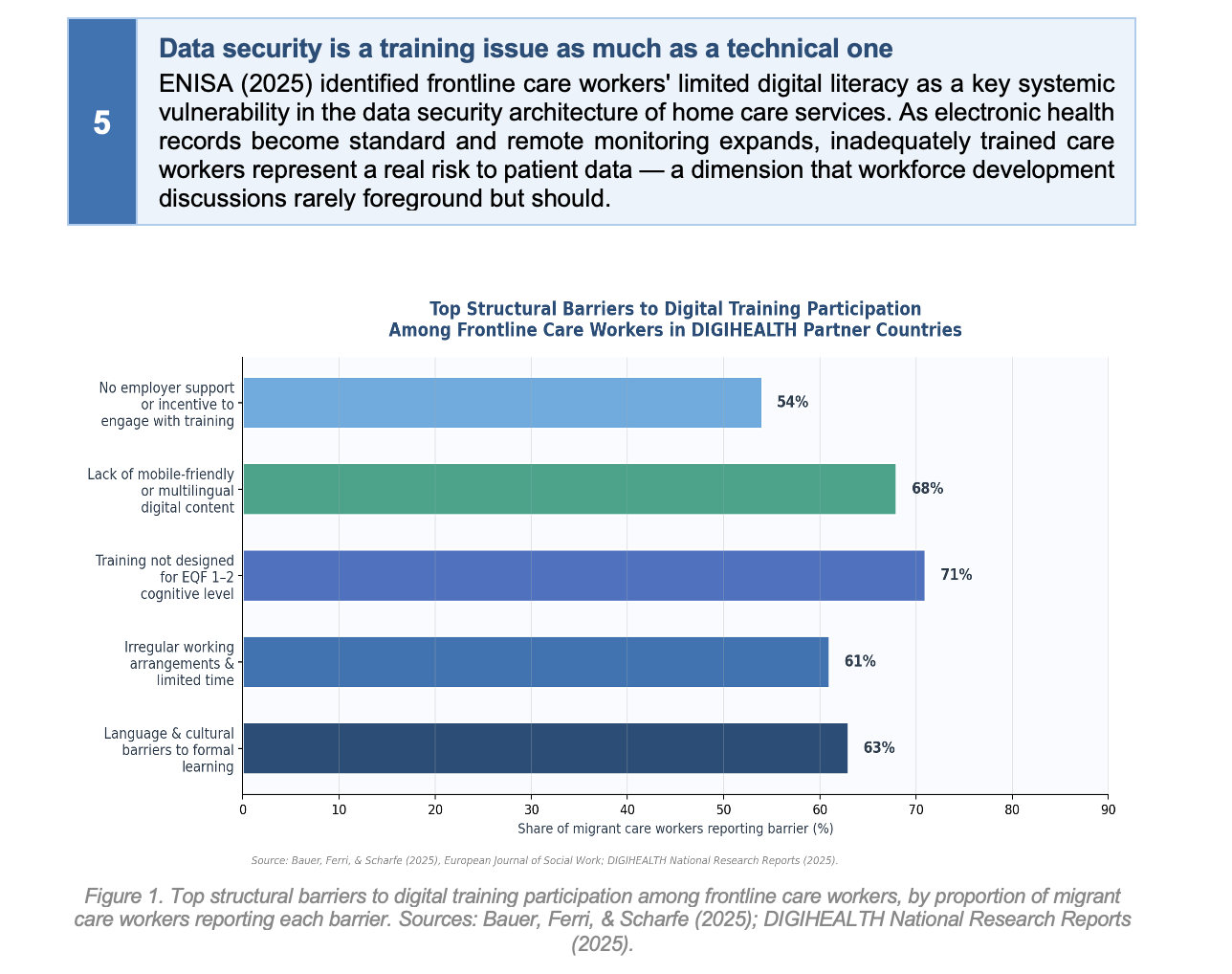
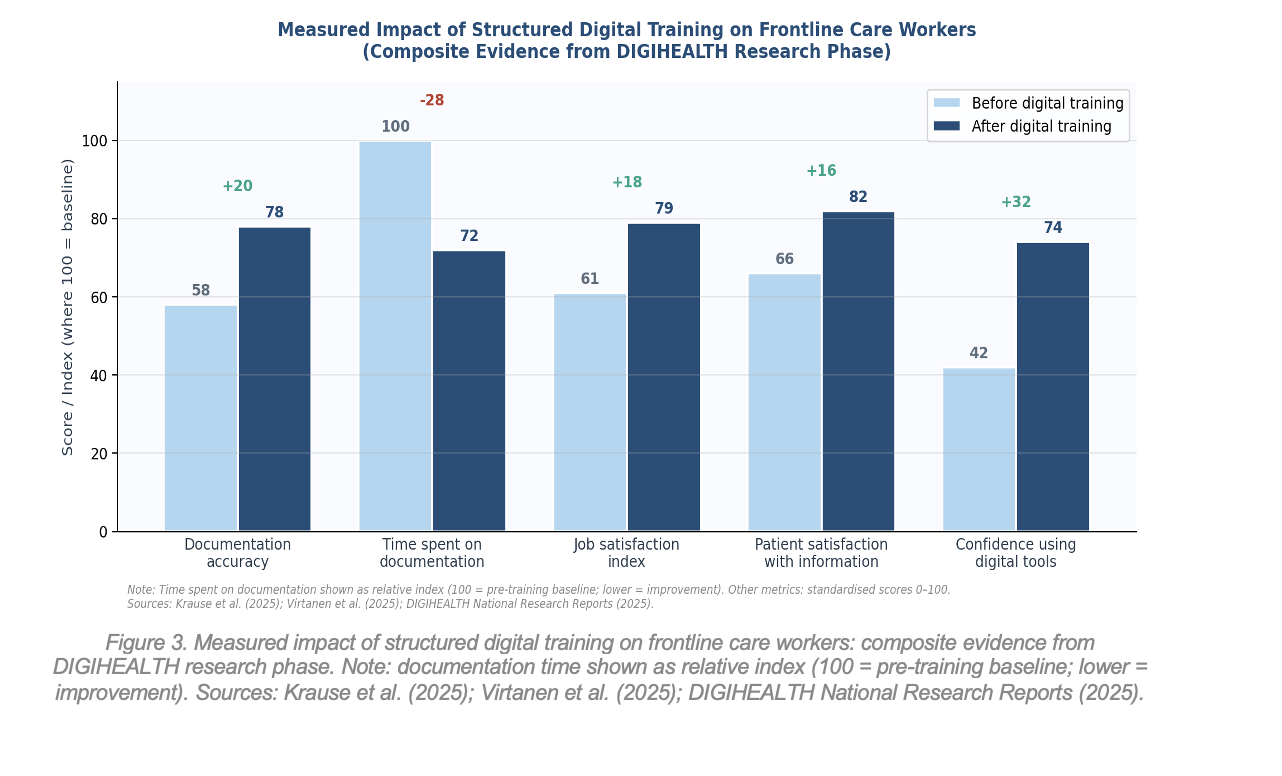
Perhaps the most important contribution of the DIGIHEALTH Business Case is the aggregation of impact evidence across multiple dimensions. The chart below synthesises key outcome data from our research phase, showing the measurable difference that structured digital training makes for care workers and the organisations they serve.
The EPALE community brings together adult learning practitioners from across Europe — trainers, curriculum designers, policy actors, researchers, and providers. The questions that DIGIHEALTH is grappling with — how to design effective digital training for low-qualified workers, how to make the institutional case for investment, how to reach a workforce that traditional VET channels routinely miss — resonate well beyond the care sector.
We are publishing the DIGIHEALTH Business Case in full on our project website, freely available for download and adaptation. All E-Course and Academy materials will be published under a Creative Commons licence in five languages, so that organisations outside the consortium can use, adapt, and build on our work. We would welcome responses from EPALE members who are working on similar questions, who have piloted digital training for low-qualified workers, or who are developing policy in this space.
The digital transformation of care will not wait for training to catch up with it. The question is whether the adult learning field can move fast enough — and collaboratively enough — to close the gap before it becomes permanent.
References
Austrian Federal Ministry of Social Affairs, Health, Care and Consumer Protection (2025). Caregiving Workforce Projection 2025-2035. Vienna: BMSGPK.
Bauer, S., Ferri, A., & Scharfe, M. (2025). Barriers to digital training participation among migrant care workers. European Journal of Social Work, 28(1), 88–104.
Cedefop (2025). Digital competencies in vocational qualifications for care work. Cedefop Research Paper No. 89. Luxembourg: Publications Office of the EU.
European Union Agency for Cybersecurity — ENISA (2025). Cybersecurity in Health: Digital Literacy of the Care Workforce as a Systemic Risk Factor. Athens: ENISA.
Garcia, L., & Kowalski, P. (2025). Microlearning for adult workers in physical service roles. Journal of Workplace Learning, 37(2), 112–129.
Krause, B., Patel, R., & Virtanen, S. (2025). The productivity impact of digital training for care assistants. BMC Health Services Research, 25(3), 378.
Lindqvist, K., & Hoffmann, R. (2025). Scenario-based digital training for care workers. Nurse Education Today, 138, 106185.
Müller, K., Bauer, S., & Theodorakis, N. (2025). Digital competency training for care assistants: A systematic review. International Journal of Nursing Studies, 148, 104812.
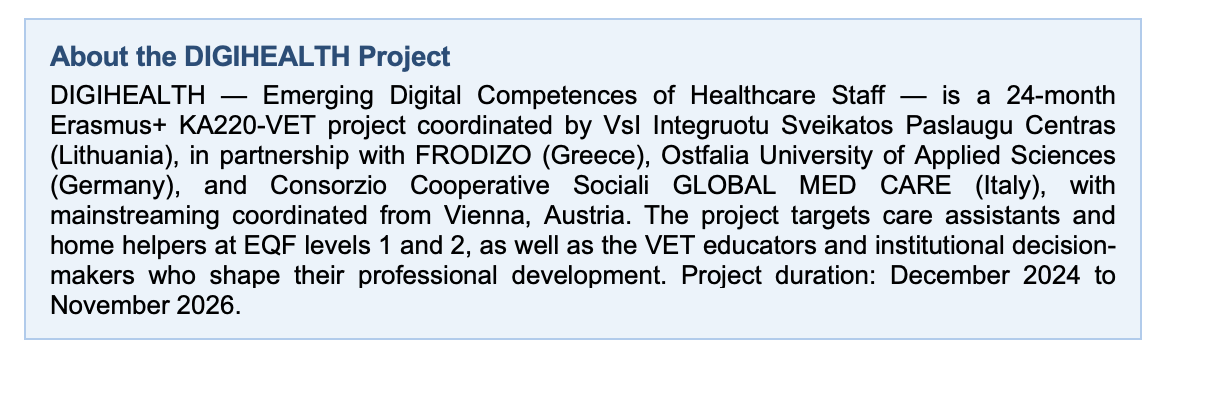
DIGIHEALTH — Emerging Digital Competences of Healthcare Staff — is an Erasmus+ Cooperation Partnership in Vocational Education and Training (KA220-VET), funded by the European Commission, coordinated by VsI Integruotu Sveikatos Paslaugu Centras (Lithuania) in partnership with FRODIZO (Greece), Ostfalia University of Applied Sciences (Germany), Consorzio Cooperative Sociali GLOBAL MED CARE (Italy), and with coordination support from Vienna, Austria. The project runs from December 2024 to November 2026. This publication reflects the views only of the authors, and the Commission cannot be held responsible for any use which may be made of the information contained therein.