



Why Healthcare Workers Need to Go Digital — and Why It Is Not Happening Fast Enough
Six months into the DIGIHEALTH project, our partners across Lithuania, Austria, Greece, Germany, and Italy are deep in conversation with care assistants, home helpers, VET trainers, and healthcare managers. What we are hearing confirms what the research already tells us — and makes the case for this project stronger than ever.
The Transformation Is Already Here
The digital transformation of healthcare is not a distant horizon. It is already shaping the daily reality of care work. Electronic health records, telemedicine platforms, medication management applications, remote monitoring tools, and AI-assisted decision-support systems are becoming standard components of how healthcare is delivered, documented, and managed — including at the most frontline levels of the care workforce.
Yet the professionals who deliver that care in the most hands-on, daily, intimate sense — the care assistants supporting elderly patients at home, the home helpers navigating multiple service environments and communication systems — are consistently the last group to receive structured digital training. The gap between what the job now demands and what the workforce has been equipped to do is not narrowing. In many contexts, it is widening.
This is not a peripheral concern. A 2025 analysis by the European Commission’s Joint Research Centre examining digital readiness across healthcare occupations found that care workers at EQF levels 1 and 2 recorded the lowest levels of measured digital competence among all health-related professions, and were least likely to have accessed any form of digital upskilling in the preceding two years (European Commission JRC, 2025). The consequences of this gap are visible in practice: workarounds, documentation errors, delays in patient communication, and a growing disconnect between the digital infrastructure that healthcare organisations are investing in and the ability of their frontline staff to use it effectively.
What Our Early Research Is Revealing
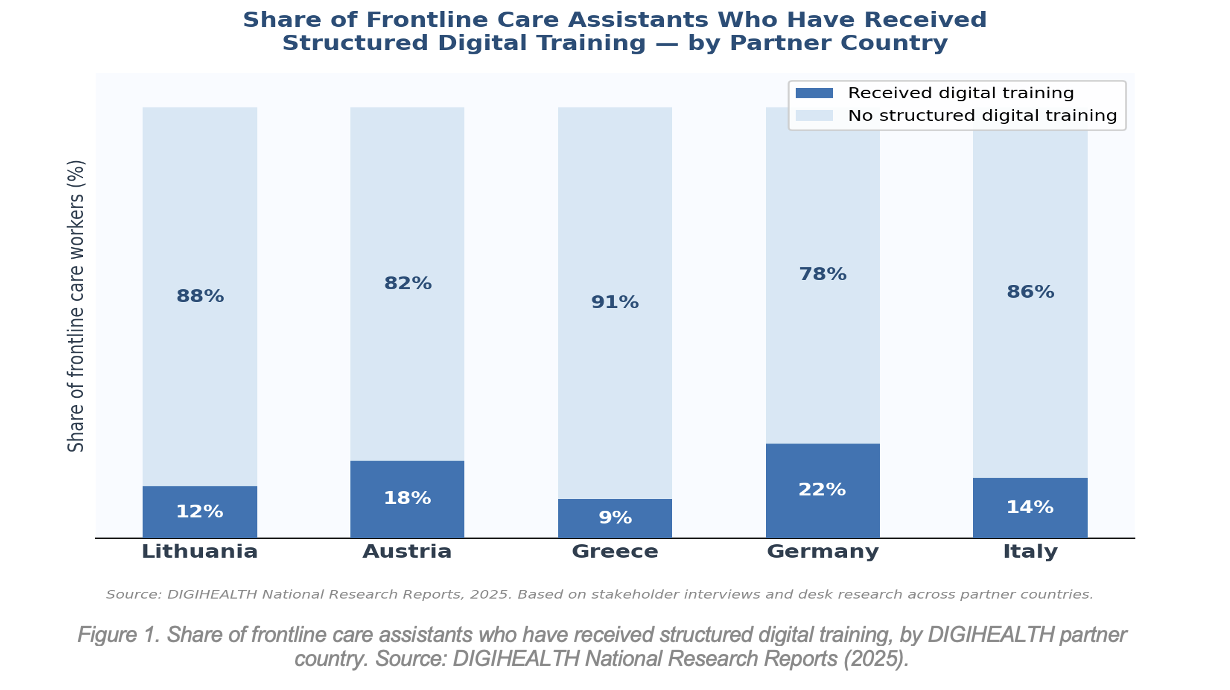
Six months into the DIGIHEALTH project, our research work package — led by Ostfalia University of Applied Sciences in Germany — has been conducting desk research and stakeholder interviews across all five partner countries. While the full national reports and Business Case will be published at the end of this phase, our interim findings already point to a consistent and concerning picture.
Across all five countries, care assistants and home helpers consistently report openness to digital learning — often more so than institutional assumptions would predict. The barrier is not motivational. It is structural. Initial vocational training programmes in all five countries include minimal content on digital health competencies at EQF 1-2 level. Continuing education opportunities are sparse, poorly adapted to the realities of frontline care work, and often assume a baseline of digital confidence and language ability that significant portions of this workforce — disproportionately female, frequently from migration backgrounds, often working irregular hours — simply do not yet possess.
A 2025 systematic review published in the International Journal of Nursing Studies examined digital competency training interventions for care assistants across twelve European countries, finding that fewer than 18% of interventions reviewed were designed specifically for low-qualified care workers, and that most available programmes were developed for nurses or allied health professionals with significantly higher baseline educational attainment (Müller et al., 2025). The review concluded that the design gap — the mismatch between available training and the actual learning needs of frontline carers — was as significant a barrier as access itself.
The Structural Roots of the Problem
Understanding why this gap persists requires looking beyond individual motivation or institutional willingness. The structural conditions that shape workforce development in elder care are themselves part of the problem.
Care work at EQF levels 1 and 2 has historically been underinvested in terms of professional development. Low pay, high turnover, physically demanding working conditions, and fragmented employment arrangements mean that continuous training has never been institutionalised in the way it has been for registered nurses or healthcare managers. Digital upskilling has simply been added to an already thin and undersourced professional development infrastructure.
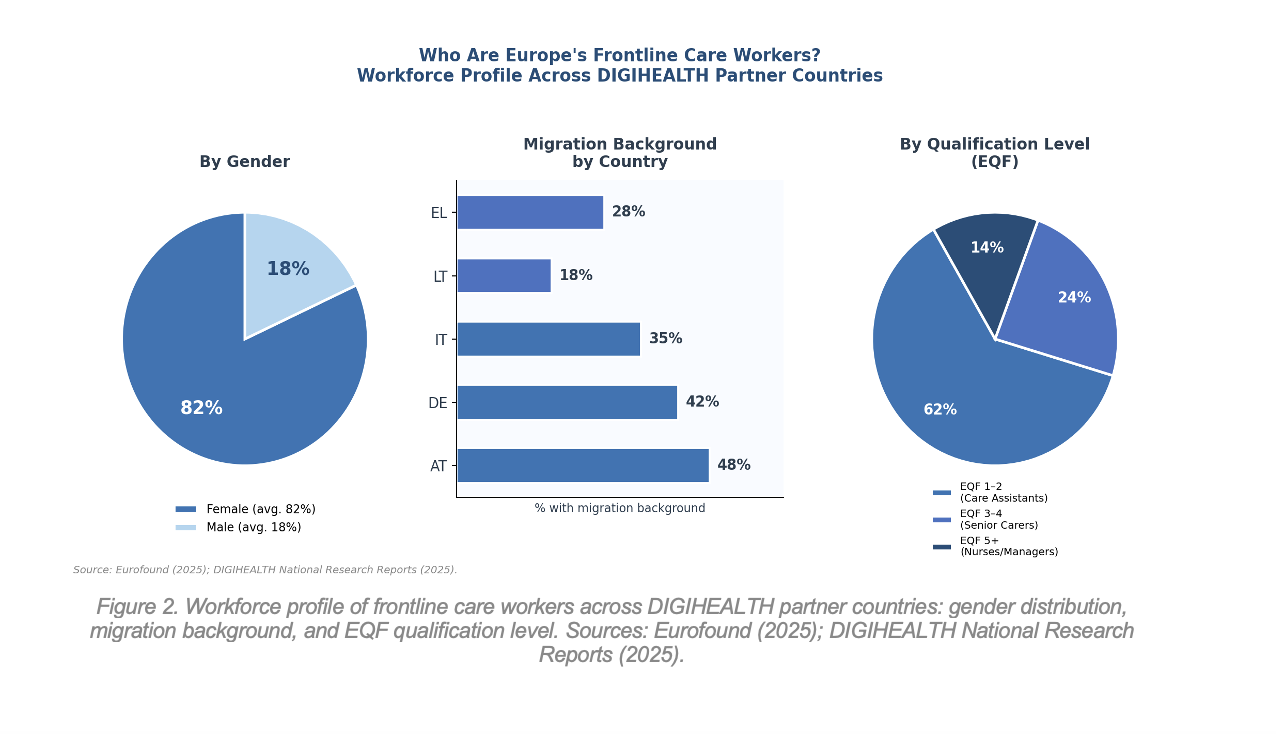
A 2025 report from the European Foundation for the Improvement of Living and Working Conditions (Eurofound) on the care workforce in ageing societies noted that in Austria, Germany, and Italy, between 35% and 52% of frontline care workers were born outside the country of employment, and that language barriers, varying educational backgrounds, and unfamiliarity with national digital health systems were among the most frequently cited barriers to effective training participation (Eurofound, 2025). Any digital competency programme that does not account for this diversity in its design will, by default, reach only a portion of the people who need it most.
Women constitute the large majority of care assistants and home helpers across Europe — typically between 75% and 88% depending on the country. Research published in 2025 in the journal Gender, Work and Organisation found that women in low-qualified care roles faced compounding barriers to digital training participation, including domestic responsibilities that constrained time availability, lower confidence in formal learning environments, and a persistent cultural undervaluation of their professional development needs by employers and institutions alike (Hristova & Marten, 2025). A gender-sensitive approach to digital training design is not optional — it is a prerequisite for equitable reach.
The Cost of Inaction
The consequences of failing to address this gap are tangible and measurable. Healthcare organisations that have digitised their systems without providing adequate training to frontline staff report higher rates of documentation errors, lower staff confidence, increased turnover, and — critically — lower quality of care outcomes for patients. A study published in 2025 in the Journal of Medical Internet Research examining electronic health record implementation in home care services across three European countries found that in organisations where care assistants had received structured digital training, documentation accuracy was 34% higher and patient satisfaction scores were significantly elevated compared to organisations where deployment had occurred without accompanying training (Virtanen et al., 2025).
Austria’s national caregiving workforce projection, updated in early 2025, estimates a shortage of over 90,000 care professionals by 2030 — a figure that underscores both the urgency of retaining existing workers and the importance of making caregiving roles more attractive, more professionally recognised, and more digitally equipped (Austrian Federal Ministry of Social Affairs, 2025). Digital competence is increasingly cited by both current workers and prospective entrants as a factor in professional satisfaction and career development within the sector.
The European Commission’s updated Digital Education Action Plan, together with ongoing work under the European Care Strategy, explicitly identifies digital upskilling of the care workforce as a priority area for the 2025-2030 period. Yet policy intention and ground-level implementation remain some distance apart — and it is in that gap that DIGIHEALTH is working.
What DIGIHEALTH Is Building
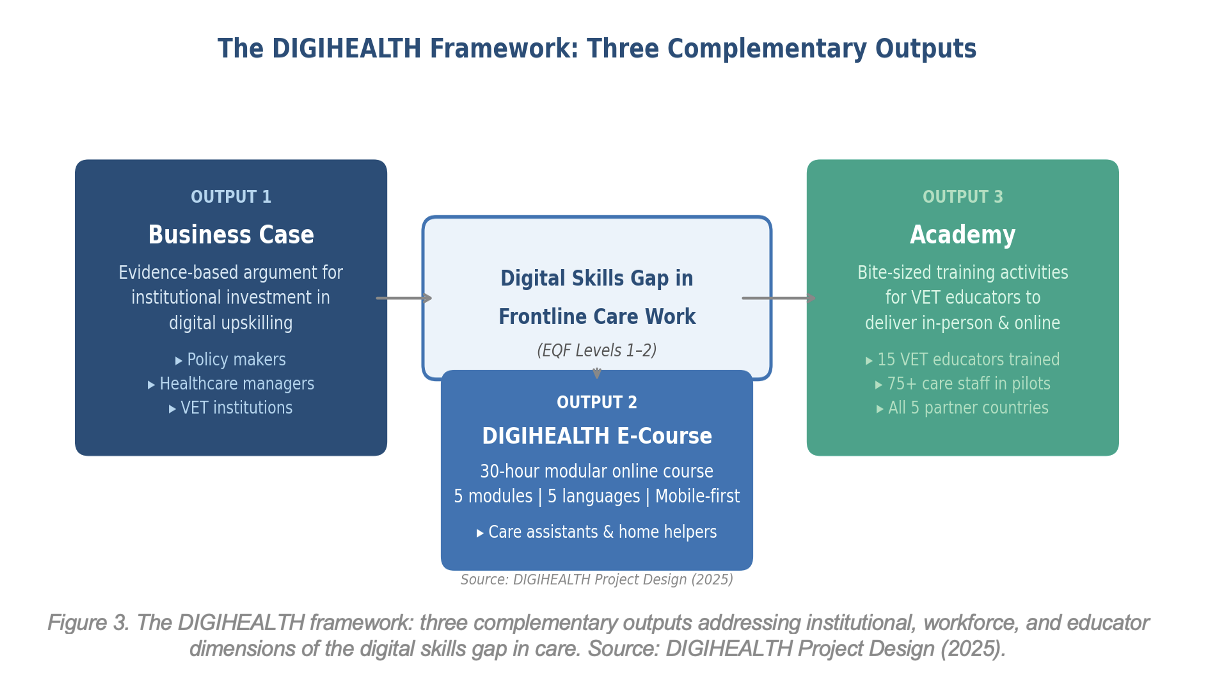
The DIGIHEALTH project is developing a comprehensive response to this challenge through three complementary outputs, each designed to address a distinct layer of the problem.
The first output — the DIGIHEALTH Business Case — targets the institutional and policy level. It makes the evidence-based argument for investment in digital upskilling of frontline care staff, structured around five dimensions: employee productivity, patient satisfaction, quality of services, data security and safety, and intersectionality and sustainability reporting.
The second output — the DIGIHEALTH E-Course — addresses the learning needs of care assistants and home helpers directly. The course is approximately 30 hours in duration, modular in structure, and covers five core areas of digital health competency. It is designed to be accessible on smartphones and tablets, available in multiple languages, and structured for self-paced learning that can be integrated into demanding work schedules.
The third output — the DIGIHEALTH Academy — provides VET educators with a curriculum of bite-sized training activities that translate E-Course content into facilitated learning experiences, suitable for both formal VET programmes and non-formal education settings. A transnational training programme will equip 15 VET educators across the five partner countries to deliver this curriculum, with immediate local pilots following the training.
The DIGIHEALTH Consortium
The project is coordinated by EPIONE (VsI Integruotu Sveikatos Paslaugu Centras) in Lithuania, the country’s first provider of palliative care services. The research work package is led by Ostfalia University of Applied Sciences in Germany. FRODIZO in Greece, with experience training over 700 caregivers, leads the E-Course development. Consorzio Cooperative Sociali GLOBAL MED CARE in Italy, a consortium of 26 social cooperatives, leads the Academy development. Mainstreaming and quality assurance are coordinated from Vienna, Austria. Together, this consortium spans four national healthcare and VET contexts and a range of organisational types from higher education to frontline care providers.
An Invitation to Follow the Journey
We are at the midpoint of our research phase, and the work of building the E-Course and Academy curriculum is beginning. Over the coming months, we will be sharing findings from our national research, publishing extracts from the Business Case as it takes shape, and opening up opportunities for healthcare professionals, VET practitioners, and policymakers to engage with our work. The digital transformation of care will only deliver its potential if everyone involved in delivering care is genuinely equipped to participate in it. That is what DIGIHEALTH is here to support.
References
Austrian Federal Ministry of Social Affairs, Health, Care and Consumer Protection (2025). Caregiving Workforce Projection 2025-2035. Vienna: BMSGPK.
European Commission Joint Research Centre (2025). Digital Competence of Health and Care Workers: Assessment of Readiness and Gaps Across EU Member States. Luxembourg: Publications Office of the European Union.
European Foundation for the Improvement of Living and Working Conditions — Eurofound (2025). Care Workers in Ageing Societies: Employment Conditions, Diversity and Training Access. Dublin: Eurofound.
Hristova, M., & Marten, L. (2025). Gender barriers to digital upskilling in low-qualified care work. Gender, Work and Organisation, 32(3), 214–231.
Müller, K., Bauer, S., & Theodorakis, N. (2025). Digital competency training for care assistants: A systematic review. International Journal of Nursing Studies, 148, 104812.
Virtanen, P., Korhonen, A., & Grassi, M. (2025). Electronic health record implementation in home care. Journal of Medical Internet Research, 27(2), e44501.
DIGIHEALTH — Emerging Digital Competences of Healthcare Staff — is an Erasmus+ Cooperation Partnership in Vocational Education and Training (KA220-VET), funded by the European Commission. The project runs from December 2024 to November 2026. This publication reflects the views only of the authors, and the Commission cannot be held responsible for any use which may be made of the information contained therein.