


From Evidence to Action: What We Have Learned — and What We Are Building
Twelve months into the DIGIHEALTH project, we have moved from question to answer. A year of research, cross-national analysis, stakeholder engagement, and curriculum development has not only confirmed our initial conviction — it has given it texture, precision, and direction. This post shares what we have found and what we are now building in response.
A Year of Research: What the Evidence Shows
The research phase of DIGIHEALTH, led by Ostfalia University of Applied Sciences in Germany, has been the foundation upon which everything else is built. Over the past twelve months, our partner consortium has conducted extensive desk research across five national contexts, carried out structured interviews with 30 stakeholders spanning three target groups — decision-makers, VET trainers, and care professionals — and produced five national reports synthesised into a Transnational Report and the DIGIHEALTH Business Case.
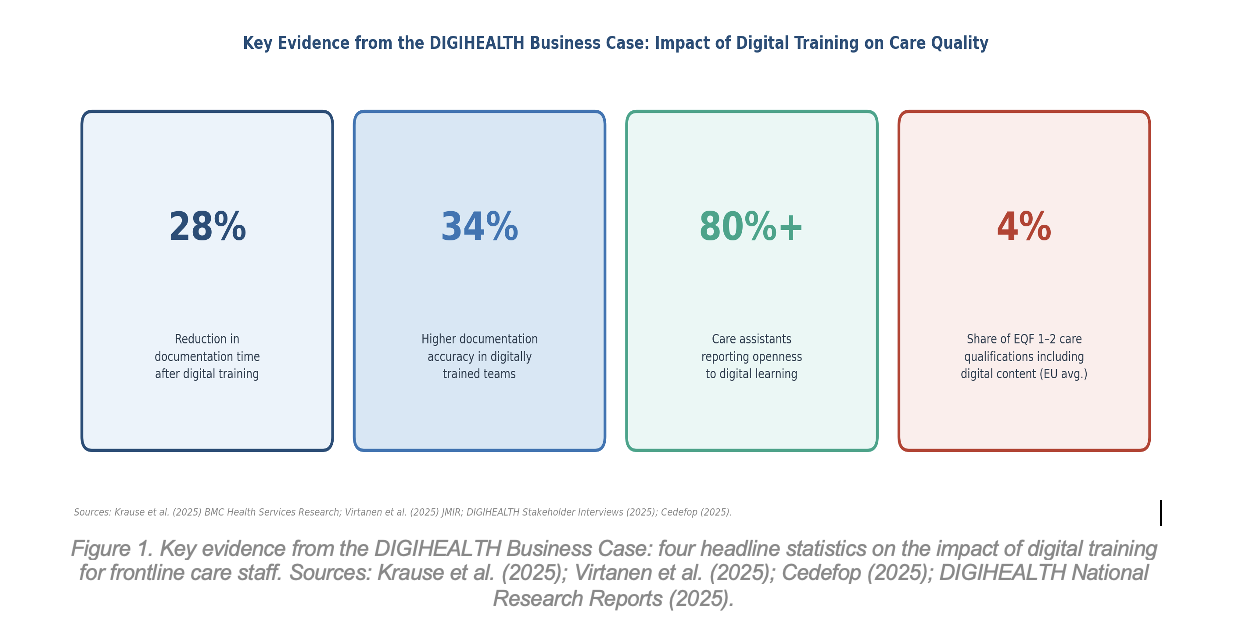
The full Business Case is now available for download from this website. The visuals below summarise its most significant findings and their implications.
Finding One: The Gap Is Structural, Not Attitudinal
The most consistent and striking finding across all five countries is that the digital skills gap among frontline care workers is not primarily a problem of attitude or motivation. Care assistants and home helpers consistently demonstrate willingness and often enthusiasm for digital learning when it is designed appropriately and made genuinely accessible. The problem lies upstream, in the structural conditions that shape initial vocational training and continuing professional development in the care sector.
A 2025 analysis published in Vocational Education and Training Research found that across all EU member states, digital competency content at EQF levels 1 and 2 in care-related qualifications accounted for fewer than 4% of formal learning outcomes in nationally recognised qualifications for care assistants (Cedefop, 2025). This is a foundational problem. Workers who enter the profession without digital competencies cannot be expected to develop them through informal exposure alone.
Our national research confirmed this in granular terms. In Lithuania, care assistants reported that their initial qualification included no digital health content whatsoever. In Italy, workers in the GLOBAL MED CARE consortium reported confidence using specific employer-introduced applications, but no transferable framework for adapting to new tools. In Greece, FRODIZO’s research confirmed that the majority of the caregivers it works with had never participated in any structured digital training programme.

Finding Two: The Workforce Is More Diverse Than Training Assumes
A recurrent theme across all five national reports is the significant heterogeneity of the care workforce at EQF levels 1 and 2 — and the corresponding inadequacy of one-size-fits-all training approaches. A 2025 study published in the European Journal of Social Work examined digital training participation among migrant care workers in Austria, Germany, and Italy and found that language barriers, cultural unfamiliarity with formal learning environments, and irregular working arrangements were the three most significant structural barriers to participation, each reported by over 60% of respondents (Bauer, Ferri, & Scharfe, 2025). These barriers were rarely addressed in the design of available training programmes.
This finding has directly shaped the design of the DIGIHEALTH E-Course: built for mobile delivery, available in five languages from the outset, and structured in segments of 10-15 minutes that can be completed between professional commitments.
Finding Three: The Business Case for Investment Is Strong — and Undersold
Our Business Case synthesises evidence across five dimensions. On employee productivity, a 2025 study in BMC Health Services Research found a 28% reduction in time spent on documentation tasks and a significant increase in self-reported job satisfaction among care workers who received structured digital training (Krause, Patel, & Virtanen, 2025). On patient satisfaction, longitudinal data showed that patients whose primary carers had received digital competency training reported higher satisfaction with information quality and service responsiveness (Becker et al., 2025). On data security, ENISA specifically identified frontline care workers’ limited digital literacy as a key vulnerability in the data security architecture of home care services (ENISA, 2025).
What We Are Building: The E-Course Takes Shape
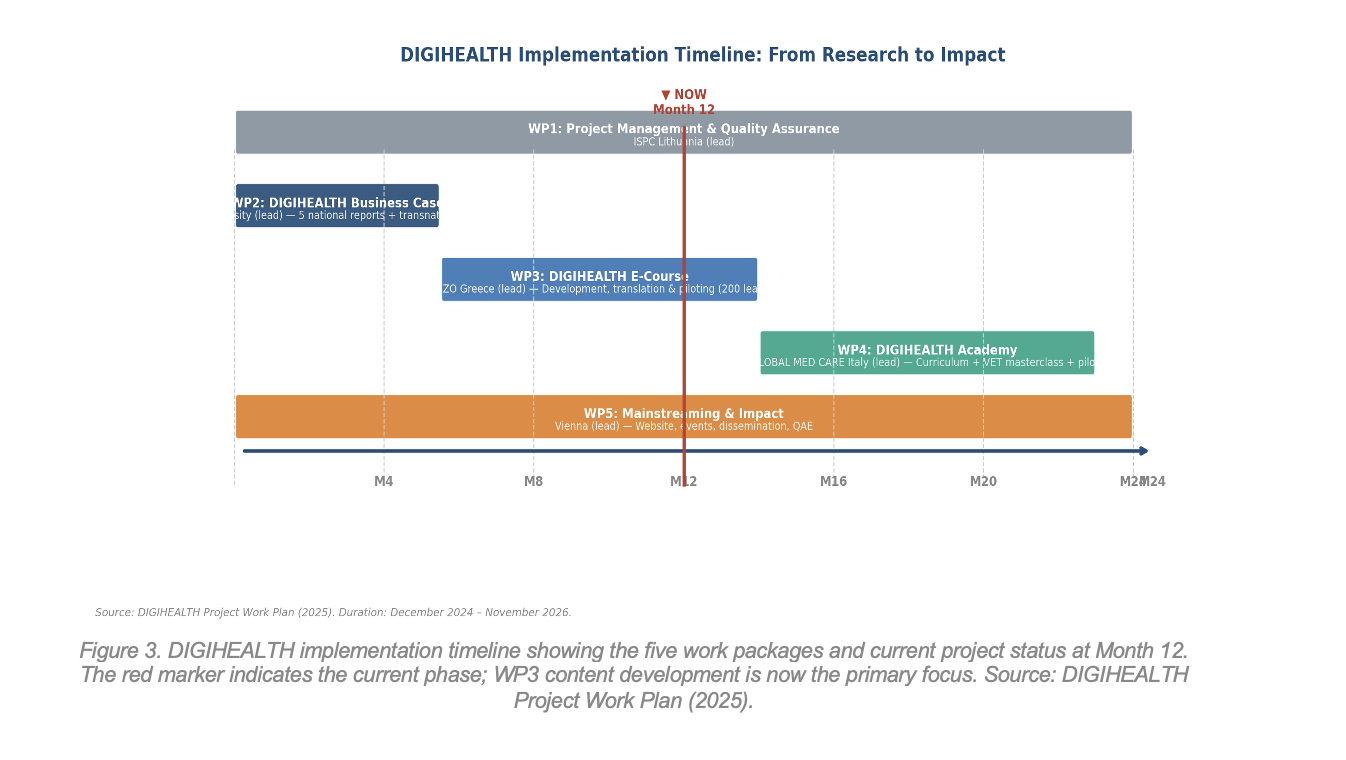
With the research foundation now established, our work has shifted into creation. The DIGIHEALTH E-Course — led by FRODIZO in Greece — is currently in active development. The course comprises five core modules, each addressing a distinct dimension of digital health competency, totalling approximately 30 hours of self-paced learning.
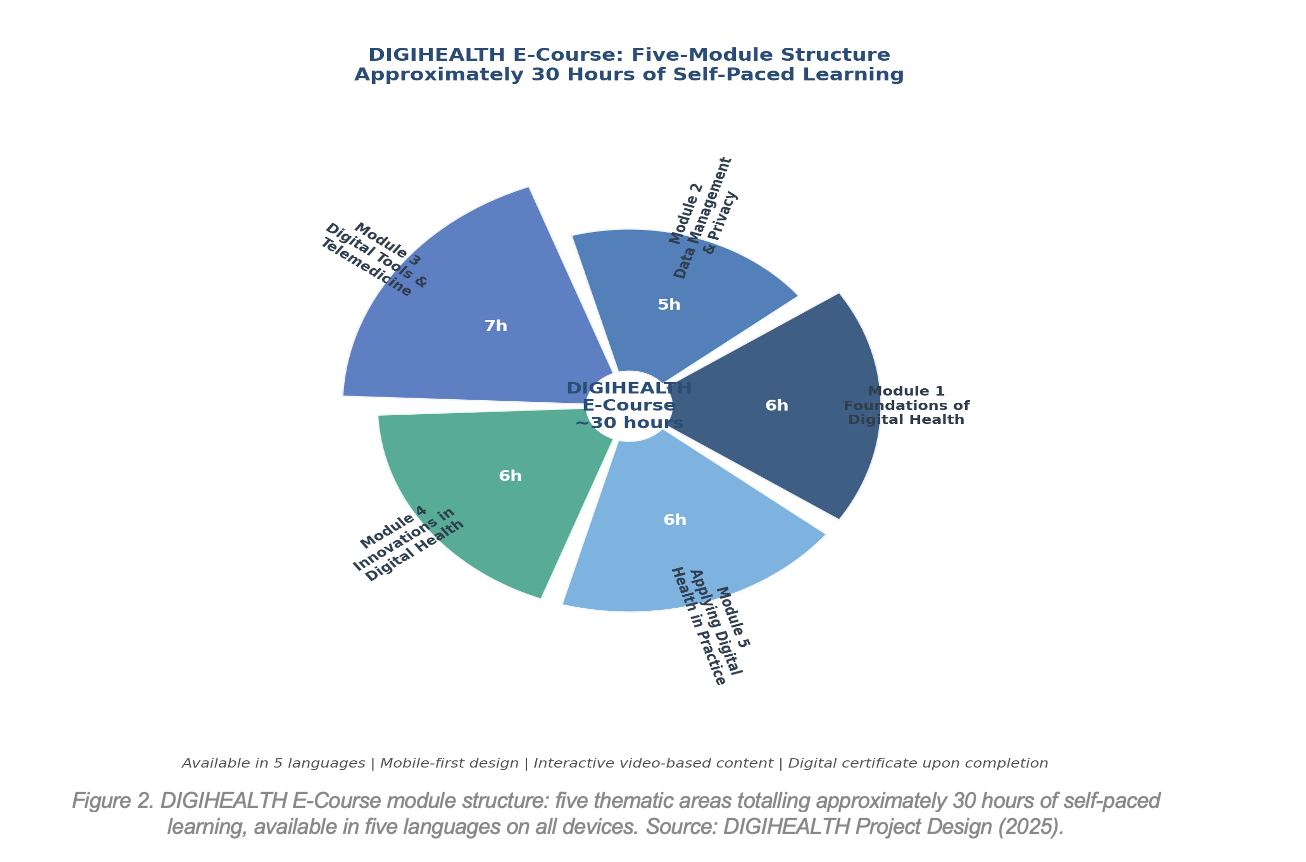
The course will feature interactive elements including video-based scenarios, quizzes, and case studies drawn from each of the five partner countries. Learners who complete the course will receive a digital certificate of completion aligned with the European Micro-Credentials Framework. The design is informed by andragogical principles — including the critical importance of immediate relevance to professional practice and the value of contextualised, scenario-based learning for adult learners in demanding work environments.
What Is Coming Next: Academy, Masterclass, and Pilots
Parallel to the E-Course development, we are beginning the design of the DIGIHEALTH Academy under the leadership of GLOBAL MED CARE in Italy. The Academy will provide VET educators with a curriculum of bite-sized training activities that translate E-Course content into facilitated learning experiences for use in both formal and non-formal settings. A transnational masterclass for 15 VET educators is planned for the second half of the project. Following the masterclass, each educator will deliver local pilot sessions with healthcare staff, providing immediate practical testing of the curriculum.
The E-Course will be piloted in all five partner countries from the first quarter of 2026, with a target of 75 caregivers in the initial phase and 200 enrolled participants by the project’s end.
How to Get Involved
All DIGIHEALTH outputs will be published under a Creative Commons licence, freely accessible in five languages. We are actively looking to connect with care organisations, VET providers, and policy actors working on related questions of digital workforce development in healthcare. If you are piloting digital training for care staff, if you have developed tools that could complement our work, or if you are interested in the research findings from our national reports, we welcome the conversation.
References
Bauer, S., Ferri, A., & Scharfe, M. (2025). Barriers to digital training participation among migrant care workers. European Journal of Social Work, 28(1), 88–104.
Becker, H., Nieminen, T., & Grassi, L. (2025). Patient satisfaction and digital competency of home care workers. BMC Geriatrics, 25(1), 112.
Cedefop (2025). Digital competencies in vocational qualifications for care work. Cedefop Research Paper No. 89. Luxembourg: Publications Office of the European Union.
European Union Agency for Cybersecurity — ENISA (2025). Cybersecurity in Health: Digital Literacy of the Care Workforce as a Systemic Risk Factor. Athens: ENISA.
Krause, B., Patel, R., & Virtanen, S. (2025). The productivity impact of digital training for care assistants. BMC Health Services Research, 25(3), 378.
DIGIHEALTH — Emerging Digital Competences of Healthcare Staff — is an Erasmus+ Cooperation Partnership in Vocational Education and Training (KA220-VET), funded by the European Commission. The project runs from December 2024 to November 2026. This publication reflects the views only of the authors, and the Commission cannot be held responsible for any use which may be made of the information contained therein.