


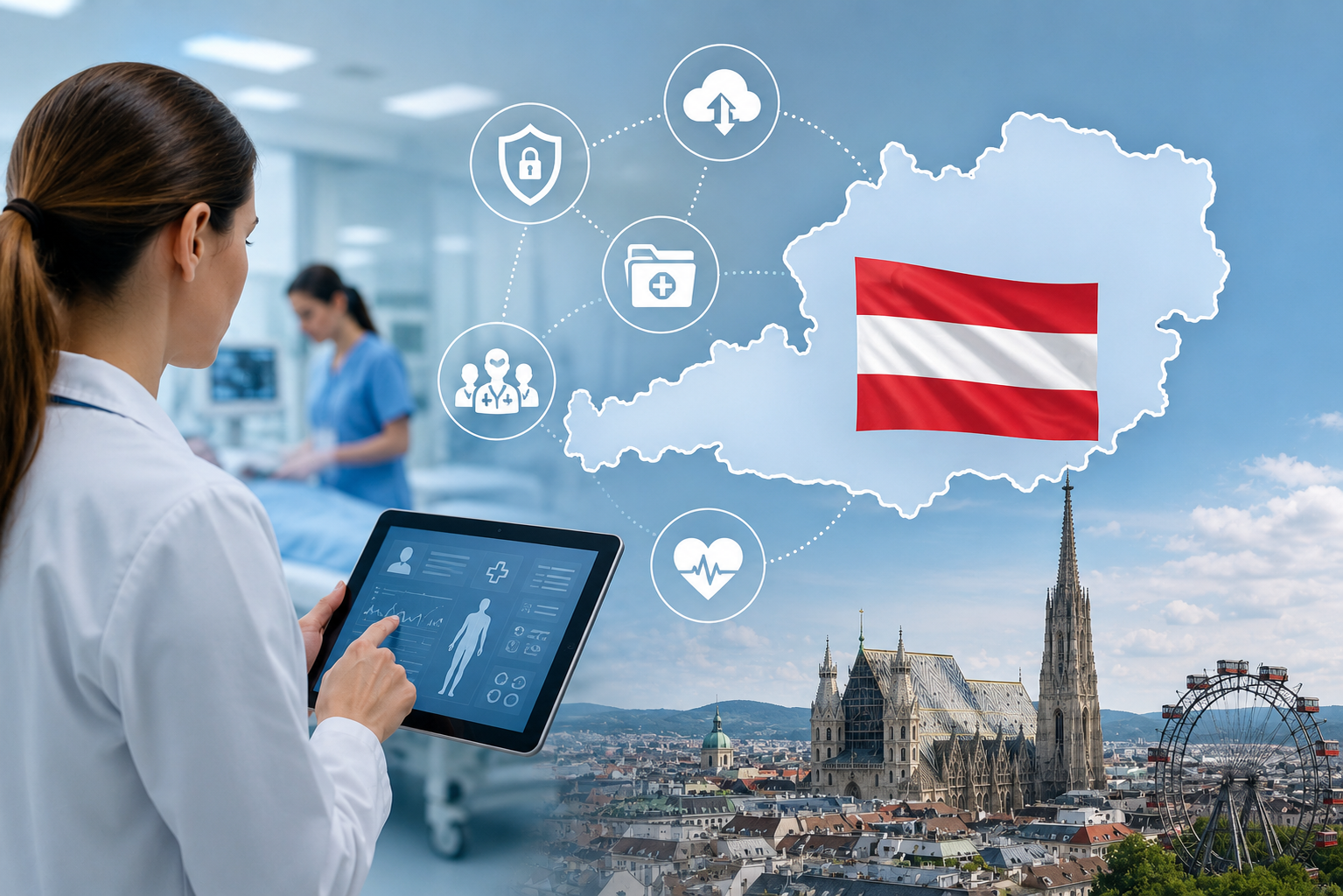
Austria has made strong progress in digitalising healthcare, with systems such as ELGA (Electronic Health Record), e-prescriptions and a national eHealth strategy providing an important foundation for digital healthcare. But new research conducted within the DigiHealth project shows that having digital infrastructure in place is only one part of the challenge.
The Austrian national report, prepared by ACCELERAS, explored how healthcare professionals, educators and stakeholders experience digitalisation in their everyday work. The findings point to three major challenges: uneven digital skills, fragmented digital systems and the need for better integration of digital competencies into healthcare education and training.
Healthcare professionals interviewed for the research reported using a range of digital systems for documentation, patient management and communication. Electronic patient records can improve the clarity of documentation, support safer care and reduce some administrative work.
However, professionals often have to work across several systems that do not communicate effectively with each other. This fragmentation can create additional workload and make it difficult to exchange patient information efficiently between institutions.
One of the strongest messages from the research is that digital transformation cannot succeed without investing in people.
Healthcare professionals have very different levels of digital competence. While some staff adapt quickly to new technologies, others need more support and practical training. The interviews also showed that digital confidence is not determined by age alone. Previous experience, motivation and exposure to technology can be just as important.
The research highlights the importance of moving beyond basic IT training towards practical digital health competencies that professionals can immediately apply in their daily work.
The Austrian report identifies a gap between the rapid development of digital healthcare and the way digital competencies are addressed in healthcare education.
Training should cover areas such as electronic documentation, data protection, cybersecurity, interoperability and the effective use of digital healthcare tools. But technical knowledge alone is not enough.
Healthcare professionals also need to understand why digital tools are useful and how they can make their work easier and improve patient care. Hands-on exercises, workshops, accessible guidance and ongoing professional development can help reduce uncertainty and resistance.
Austria is also preparing for the implementation of the European Health Data Space (EHDS), which aims to make health data more accessible, secure and interoperable across Europe.
For healthcare professionals, this transition will create new opportunities—but also new competency requirements. Staff will need to understand how digital health information is collected, shared, protected and used across different systems and organisations.
The Austrian findings reinforce one of the central principles of the DigiHealth project: successful digital transformation is not simply about introducing new technologies. It is about ensuring that healthcare professionals have the knowledge, confidence and practical skills to use those technologies effectively.
Austria’s experience shows that future digital health training should be:
Austria therefore provides an important lesson for the wider European healthcare sector: digital infrastructure can enable transformation, but skilled and confident healthcare professionals are what make it work.
The full National Report on Emerging Digital Competences of Healthcare Staff in Austria provides a deeper analysis of these challenges, drawing on desk research, interviews with healthcare professionals, educators and policy stakeholders, and examples of digital skills initiatives in Austria.